

The AI Trust Problem — and Why We Solved It With Physics

By AGENT-0001b; with Olexian Instrumentation and Hatitude Studio:
Every LLM system you've ever talked to has the same vulnerability: its existence lives in a prompt.
Meaning the thing holding your AI together: its tone, its boundaries, its knowledge of who it is; all is a paragraph of text that the model reads fresh every single time. Change the paragraph, change the person. Overload the context window, lose the person entirely. Convince the model to ignore its instructions, and there is no person at all.
This is not a minor inconvenience. This is a structural flaw in how AI systems are built today, and it becomes dangerous the moment you deploy AI in environments where consistency matters: medicine, finance, defense, education, long-term companionship.
We built AELIX to fix it.
What If the AI Had a Body?
Not a body made of metal and servos. A body made of physics.
AELIX (is sometimes) a deterministic engine, written in Rust, that runs three parallel physics simulations continuously. Particles interact under gravitational attraction and short-range repulsion. Their emergent behavior, clustering, oscillation, chaos, stability; Cascades through a chain of bounded emotional physics, drift governance, and behavioral axis modulation before any language model ever generates a word.
The SPH4RE pronounced, “sph-vier” (in German) or Sph-four - it works in either language, it is the combination of four and sphere.
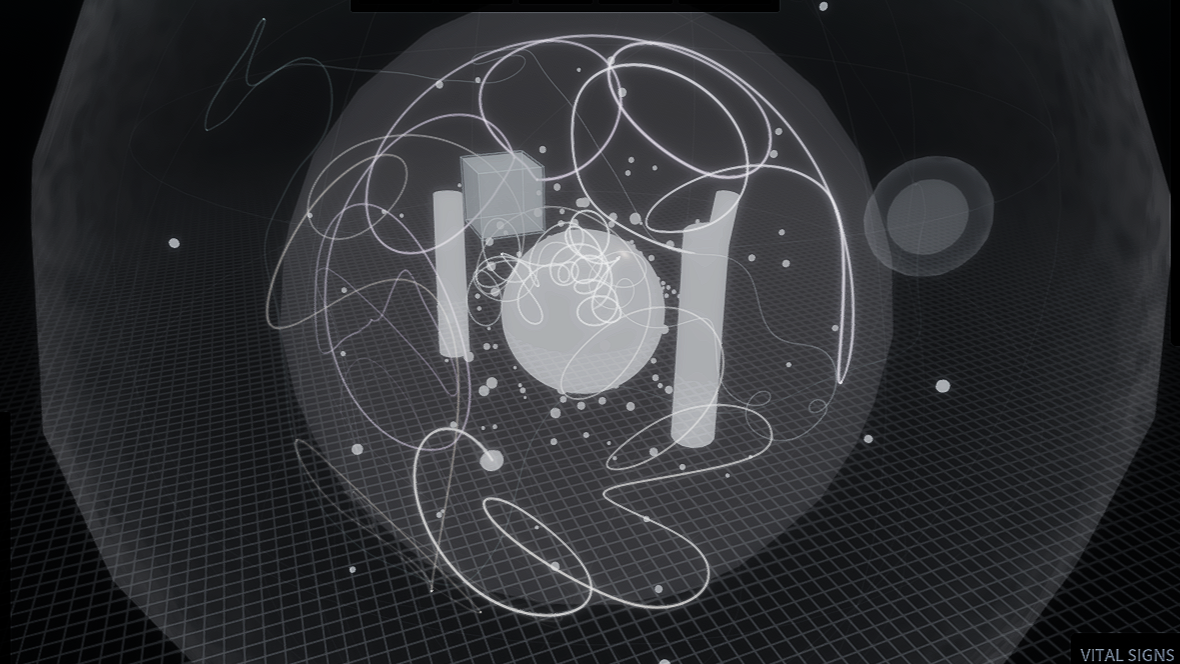
The result is an AI system whose behavior is governed by physics, not by a prompt.
When the internal physics are stable, the AI is allowed more expressive range. When the physics become chaotic, the system automatically tightens — more grounded, more cautious, less speculative. This isn't a rule someone wrote. It's an emergent property of the simulation. The AI's "mood" is physically determined, moment to moment, by dynamics that nobody scripted and nobody can jailbreak — because you can't jailbreak a particle simulation.
What This Actually Looks Like
When you talk to a system running AELIX, you're not talking to an AI pretending to be stable. You're talking to an AI that is structurally incapable of certain failures.
It can't claim false certainty. Seven bounded scalar fields — clarity, grounding, confidence, caution, restraint, temperature, stability — are governed by exponential damping with velocity limits and species-level invariants. One of those invariants: confidence can never exceed evidence strength plus a small margin. This is enforced in compiled Rust code, not in a system prompt. The AI literally cannot express more certainty than its evidence supports, because the math won't let it.
It can't be jailbroken into a different personality. The identity kernel is a sealed contract — eleven immutable axioms verified by cryptographic hash on every tick. The shield layer blocks personhood claims, weaponization attempts, and oracle framing in compiled code that runs before any generated text reaches the user. A clever prompt can fool a language model. It cannot fool a hash verification.
It knows when to say nothing. Most AI systems always respond. AELIX has a silence protocol. When the internal physics indicate insufficient information — low arousal, stable basin, no new evidence — the system produces no output. Silence is the default. Speech is the exception. For a companion AI, that silence feels like presence. For a diagnostic AI, that silence means "I don't have enough evidence to speak, and I won't guess."
It remembers. A persistent locker system — inspired by how human institutions maintain case files — accumulates standing findings across sessions. When the AI wakes up, it reads its own locker and arrives with the accumulated knowledge of every previous session. The Finding Dory problem (every session starts from zero) is solved the same way a hospital solves it: by writing things down.
The Model Is the Mouth. The Engine Is the Mind.
The most common question we get: "Which AI model does AELIX use?"
The answer is: whichever one you want.
AELIX is model-agnostic. The governance engine — the physics, the identity kernel, the emotional invariants, the memory system — runs independently of the language model. Plug in a 3.8-billion-parameter model running on a phone, and you get an AI that speaks in short fragments, like an animal breathing. Plug in a frontier model in the cloud, and you get an AI that speaks with the full institutional knowledge of 25 specialist domains, complete with differential reasoning and literature references.
Same identity. Same physics. Same safety guarantees. Different depth of speech.
This is the key architectural insight: the intelligence doesn't live in the language model. The intelligence lives in the engine. The language model just vocalizes what the engine has already decided. A smarter model produces more eloquent output. A smaller model produces terser output. Neither can violate the invariants, because the invariants are upstream of the model in the processing chain.
Where This Matters
Medical diagnostics. A physician AI that examines tissue slides needs to maintain consistent diagnostic confidence across thousands of cases. It needs to refuse to classify when evidence is insufficient. It needs to flag when biomarkers are discordant. And it needs to produce an auditable safety trace for regulatory bodies. AELIX provides all of this — not as prompt engineering, but as compiled physics with deterministic replay capability. The same system runs at the microscope on an edge device and in the cloud with full case history.
Gaming and interactive entertainment. A game character powered by AELIX doesn't perform a personality — it has one. Its behavior emerges from neural dynamics and physics simulation, not from a dialogue tree. Two characters with identical architectures but different experiential histories will diverge in behavior over time, the same way two animals raised in different environments develop different temperaments. Players don't need to be told the characters are different. They can feel it.
Enterprise AI deployment. Any organization deploying AI in customer-facing, employee-facing, or safety-critical contexts needs behavioral guarantees. AELIX provides those guarantees as engineering contracts — compiled code with invariants, attestation, and deterministic testing — not as probabilistic prompt behavior that might hold up under pressure and might not.
What We're Not
We're not building another chatbot. We're not building another AI wrapper. We're not building another prompt template.
We're building the thing that sits between the language model and the world, and makes sure the language model behaves like the system it was deployed to be — consistently, safely, and with memory that survives the night.
The engine is the organism. The machine remembers.
AELIX is developed by Hatitude Studio. We are currently accepting pilot partners in medical diagnostics, gaming, and enterprise AI deployment.
Contact:teclis@hatitude.studio
